Friday, May 12, 2017

SEO for Photos, Visuals, and Graphics + How to Rank in Google Image Search - Whiteboard Friday

Posted by randfish

When a third of all searches performed in Google are for images and 12.5% of SERPs show Image Pack results, you know it's not a facet of SEO to be trifled with. Today's episode of Whiteboard Friday is densely packed with all the image SEO tips you could ever want, from the bare basics to ranking factors to important next-steps.

SEO for photos, visuals, and graphics

Click on the whiteboard image above to open a high-resolution version in a new tab!

Video Transcription

Howdy, Moz fans, and welcome to another edition of Whiteboard Friday. This week, we're going to chat all things image SEO, so SEO for photos, for visuals, for graphics, and talk a little bit about how you rank, not just in Google Image Search, but also in Google in the Image Pack.

Image SEO basics:

Look, there are a couple of things that we should discuss before we even get into that. First off, many folks are asking...

1. "Is it still even worthwhile to do Image Search SEO?"

You might recall that in years past, when you clicked on an image in Google Image Search, you would go to the website or the webpage that had that image on it. Now, if you click it, Google opens up a full-sized version of that, tells you the website it's on. But for many people, that's enough. They do a bunch of searches and never actually visit your website. Google is just serving up your image unbeknownst to you, and you don't even get any data on that. So you don't know how many impressions it gets, all that kind of stuff. So here's the case for Image Search SEO.

  • Visually sold products and services - We've talked to many people who are contractors or decorators, remodelers, hotel owners or hoteliers, craft sellers, and they find that image search is something that people do as research before they choose them. In fact, you might see actual searches for "kitchen remodel Seattle," and then people will base their decision of who to go with based on the images that pop up there, they'll visit that website.
  • Anything that's designed to earn links and citations - So if you're producing graphs or data, or you're taking photos of events or of people, and you're hoping that those people or other folks will go and use your images and then link back to you, you definitely want to do Image Search SEO. That can get you in front of that right audience. When they use your image in their presentation or their publication or their website, you get the link.
  • Visual content licensers - Very obviously, they make their living selling images. Google Image Search is a great way to get in there. So if you're a photographer or an illustrator or a stock gallery, you certainly would want to be doing that as well.

*A couple of data points:

One comes from Jumpshot, whose U.S. dataset is fairly sizeable, in the millions of searchers. They see that about a third of all the searches performed on Google are performed in Google Image Search, which is just mind-bogglingly crazy, like huge. I never realized how big Google Image Search was until I saw that Jumpshot data. It's just massive. MozCast shows us that about 12.5% of all Google searches in the web results do show an Image Pack somewhere in there.

2. Do you have to use original visuals?

Or can you, for example, license visual content from other folks? Can you buy a stock image and put that on your site and potentially still rank for it in Google Images? The answer is, actually, yes.

  • So unlike web results, duplicates are not viewed as a problem. Google Image Search will generally take one version of an image, and that'll rank higher than the others. But it's not always the original. In fact, many times it's not the original source. It's a page that does a really good job of Image Search SEO. So this is a great opportunity for SEOs to get some extra traffic.
  • Just make sure that you have the right permissions.

3. How do you figure out if image SEO is actually something you should be doing?

Well, for any given keyword, for example, I searched for "Santa Fe architecture" here, and there's a result, I think at the top. Maybe it's an ad result. Then there's the image block with a few photos in there. Google is only going to show that image block if and when the searchers are actually clicking over to images very frequently, or there are lots of searches directly on Google Images for that term. So Google itself can sort of be that indicator for you of whether there's demand.

What are the rankings elements for Google images + image packs?

Now, if you are curious about doing this image SEO and you've decided, "Okay, this probably makes sense. I should try it out. I should do some. I've got some uses cases," my strong suggestion would be that you look at all the ranking factors. They're actually quite broad, but they're not nearly as complicated. Or they're a little more basic than we're used to with web results. I think that is because, when it comes to images, Google is mostly hyper-concerned with relevance and serving the user's interest, rather than link popularity. They don't worry as much nearly about spamming and manipulation in those results. So you can see them using a sort of more old-school style algorithm.

So here's a page with some pictures of Santa Fe on it, and things that Google might use are:

A. The image file name

B. The alt attribute on the image. Another very important reason to add alt attributes, in addition to accessibility reasons, is for Image Search SEO. It does seem to help a little bit, maybe, with web results SEO too.

C. The image caption. So this is something where we've actually seen the caption be more important than the alt attribute when it comes to Image Search. So if you put that little caption down below, underneath your image, that can actually help with the Image Search rankings.

D. Surrounding text content. So Google is going to look at this text above and below and around the images to see if it has relevance.

E. The page title, of course.

F. The page URL that it's hosted on. This is one of the reasons, by the way, that galleries of images, especially inside stock photo galleries, don't tend to do very well, because there's very little sort of relevant content surrounding them. They tend to be in these big, gallery-style layouts. So there are tons of images all in one page, when what Google is looking for is just one or two that are hyper-relevant to the particular topic, which is why most of the images you see doing really well in Google Image Search are the ones that live, not by themselves necessarily, but are the premier image on that particular page.

G. Image engagement and popularity. This is a big one. We have seen results where folks have done tests. They've shown that if you do a search on Google Images and you click the 12th image down and a lot of people start doing that, Google will move it up, just like in the web results, but sometimes even more so with images. We think engagement and popularity, what people scroll to, what they click on, what they click through to, matters quite a bit. That's why you should have a very high-quality, highly interesting, highly relevant image, as well as you also want to serve visitor demand.

H. The image dimensions matter. So if you do a Google Image Search, you will notice that they don't show, or they rarely show, unusual image dimensions. So an image like this, which is very, very horizontal and not very vertical, probably wouldn't do well. Just as a very vertical, not very horizontal one. They tend to look for sort of 16 by 9, 4 by 3, square images, and sometimes turned on their side so vertically it can work, as well. But anything much more than that and you get into problems.

I. Image size. So Google is generally not looking for very small images. They also tend not to show gigantic ones, although they sometimes will scale it down. If you do searches for anything plus "wallpaper," Google knows that the intent is for very large sizes, and so they will show that.

J. Embeds of the image. So if your visual appears on many different websites and pages, and it's been embedded multiple times, that seems to have a positive impact.

K. Traditional web ranking factors on the existing URL. So if this page, architecture.com/santafe, happened to rank well, in the top five or six or seven for "Santa Fe architecture," chances are good that images from that page would also rank in the first few images results. The reverse isn't always true. But if you can get the ranking in web results, you can generally do well in the image results as well. Why wouldn't you want to? Because you can get traffic from both.

L. Google seems to finally have gotten to the point where they have some sophistication, and they're doing a little bit of image relevance and visual match in here too. So if you have a picture of a koala, as adorable as that might be, even if you have every other factor in here, they probably won't show you for "Santa Fe architecture," at least not for long.

What steps should I take with image SEO?

Well, just a few. I want you to...

1. Determine your SEO goals, and then I want you to compare those SEO goals against your keyword research list.

2. Audit of your keyword research list for image visibility. Keyword Explorer is actually really awesome for this. I think there are probably some other tools that do it, but right now Keyword Explorer is one of the best. You can also do it in Moz Pro. You basically plug in all your keywords, you go to your list page, and you see what number of results actually have image blocks like this in them. That will tell you what kind of opportunity you've got.

If you decide that you're going to do any image SEO at all and it matches with your goals, you're then going to...

3. Create a set of guidelines for content creators/publishers on your site. I want these guidelines basically to be for anyone who's creating content on the site, if you are putting an image in, just do these three or four things.

Make sure you've got the caption right. Make sure you do the image alt attribute. Make sure that the size and dimensions are right, and you do some image optimization so it loads quickly on mobile, those kinds of things.

4. Create a target list of image SEO opportunities to pursue. So these would be like the 5 or 10, or if you're bigger, maybe 50 keywords that you know have image blocks in them, or that you know get lots of image searches, and therefore you're trying to target them. You can then go actually create the priority of, "Hey, we need a visual for this. Hey, we need to put it on a page, and we need to nail these things."

5. Audit your existing images on your site for SEO and UX optimization (size, speed compression, etc.)

Probably, there's a bunch of low-hanging fruit that you're missing out on. My recommendation, check out Ryan Ayres' "How to Perform an Image Optimization Audit" from last year on Moz's website. Really good post, walks you through how to use Screaming Frog to do this and how to optimize all those visuals.

Thanks for sticking with me through all this dense information on image SEO. I hope you rock the image rankings, and we'll see you again next week for another edition of Whiteboard Friday. Take care.

Video transcription by Speechpad.com


Sign up for The Moz Top 10, a semimonthly mailer updating you on the top ten hottest pieces of SEO news, tips, and rad links uncovered by the Moz team. Think of it as your exclusive digest of stuff you don't have time to hunt down but want to read!


Source: Moz Blog

Thursday, May 11, 2017

Why this digital marketer is supporting small businesses by standing up to “dodgy” SEO agencies

A Melbourne-based digital marketer has pledged to “stand up” to dodgy search engine optimisation (SEO) companies and support small businesses, offering to audit business’ SEO practices for free to ensure it’s correctly done.

In a post on his LinkedIn profile yesterday, digital marketer Adam Jacobs called out “dirty SEO agencies” for ripping off “honest and hardworking people”.

“I’ve spoken to some of my whitehat search homies and we have decided to start auditing your SEO work for free!” Jacobs wrote.

“Dear business owners, if you would like someone to look at your SEO agencies work and let you know if it’s actually being done or know someone who would, then tag them in here or hit me up in the comments.”

Speaking to SmartCompany this morning, “SEO vigilante” Jacobs said he didn’t expect the post to garner the attention it has, with Mumbrella also reporting on the story. He says the offer is “not so much a service as advocacy”, saying he thought it would be “a bit of fun” to mess with dodgy SEO agencies.

“I was looking into online marketing services and finding businesses were paying large sums of money and not seeing any work be done,” he days.

“Some dodgy agencies are targeting SME owners who don’t know any better [and] that are being wooed by a guy on the phone to commit to 12-month contracts at an exorbitant amount.”

Jacobs, who is digital marketing manager for a business called Launch Digital, says many businesses then don’t see any results. He believes more often than not the SEO work is either not done, or done is a “very poor” way.

The service Jacobs is offering involves a free audit of business’ SEO work, checking things like backlinks and keywords and providing a report businesses can then take to agencies to prove their case.

While Jacobs worries that some believe the service is just self-promotion, he stresses he is not seeking payment and has no “ulterior motive”. In his LinkedIn post, Jacobs told business owners, “to be clear, I don’t want your SEO work either”.

“People are always assuming an ulterior motive, but we’re not approaching this from a business standpoint. My purpose is to expose dodgy agencies and have a bit of fun demonstrating a subject matter expertise,” he says.

“This is now an epidemic — some agencies out there don’t know digital marketing from their own feet. Not all agencies are bad, but this is about making a stand against the dodgys.”

Jacobs says a number of businesses have already taken him up on his offer and contacting him with concerns over their SEO. So far, he hasn’t come across any cases of incomplete work but has educated a number of businesses on why they may not be seeing results.

“Most of the people who have approached us so far, their work has been done, but just not to the quality they wanted,” he says.

Mumbrella reports Jacobs has teamed up with marketing company Adaptis GmbH to launch the campaign, but Jacobs says no partnership is in place.

“I don’t know anything about them, I think a bunch of people just jumped on board and seen it as a good business opportunity. I don’t know them or their CEO,” he says.

For businesses concerned with the quality of any SEO work, Jacobs advises there are a number of online tools that allow businesses to self-audit their SEO work. Additionally, just Googling the name of the agency that completed the work can reveal the experiences of other businesses.

“There’s a lot of SMEs getting caught out, and to some small businesses, money for SEO could be their entire marketing budget … Getting locked into a contract could be the difference between the business surviving or not,” he says.

“I’m not saying all agencies are dodgy, there’s a lot of good intentions, but there’s also a lot of businesses getting caught out.”

“If for nothing else I’m just trying to get businesses to understand the issues and do some due diligence.”

Never miss a story: sign up to SmartCompany’s free daily newsletter and find our best stories on Twitter, Facebook, LinkedIn and Instagram.


Source: SmartCompany

How to Create a Fluid Workflow for Content Teams

A good content workflow makes your publishing process a lot more effective. This article will outline ways you can organize the work of your content team and create a workflow that simplifies content production and distribution.

Defining your target audience from the get-go makes for a good content strategy. A clear vision on your readership can help in creating a matching writing style, and it determines your content's substance as well.

Your strategy will include, at a minimum, important keywords, a description of the buyer personas you are targeting, and tips on content distribution.

Once you've planned your strategy, you'll need people to implement it.

Start by building a team, and help each team member understand the goals of your strategy. Also explain the steps and tasks involved in the publication process.


In that process, to ensure an effective workflow, you'll need to watch out for approval chains, which get out of control when responsibilities are not defined.

You might get around the chain reaction of approvals for your content if you're a small-scale operation, but it becomes more and more crucial to avoid them at larger corporations with complex mechanisms for communication.

The more time is spent going back and forth with making changes and approving content, the less time you'll have to actually create it. In the end, your readers will suffer, as will your content, reputation, and the business itself.

An effective workflow starts by assigning the tasks within your team. The specific steps will vary from organization to organization, as will the number of people involved. Only large companies are able to assign an individual team member for every task. That said, even a smaller blog could benefit from defining workflow.

Here is a list of steps you'll need to take and responsibilities you'll need to assign among various roles.

1. Find your niche topic to write about

This seems self-explanatory, although it's important. The team member who is responsible for it should have access to resources for keyword research, social media channels, and forums related to the topic.

2. Get the idea approved

Draft an abstract based on the first step, and pitch it to decision-makers. Once it's approved, your task will be a little easier.

3. Create a first draft based on topic research

You might want to get collaborators involved for in-depth articles to speed up the process and figure out a good storyline.

5. Create visual content

Get the graphic designer involved. If your team doesn't have one, you can outsource this work. Or you can use stock images (a good resource is unsplash.com).

6. Review the content

Approval is the job of content managers; they (or people they assign) need to fact-check, look for copyright issues, and decide whether the content meets the standards of the business or publication.

7. Proofread

If you can't afford to hire a team member, outsource proofreading. Even if the writer is otherwise a good proofreader, he or she would have read the content so many times that errors will inevitable sneak in.

8. Publish—on your website or other medium

9. Promotion and distribution are at least half the job!

Some people tend to forget this step. Ideally, a social media manager and other employees will share the posts on suitable channels in addition to sending it out to subscribers. Don't forget to measure results using tools, such as Google Analytics.

10. Update it once in a while

Older posts, in some cases, generate more traffic and leads than new ones. Which is why it's a good idea to regularly review and update older posts that are still visible for searchers.

* * *

If you have a smaller team, the job still has to be done, and the responsibilities and steps remain the same; they just need to be taken care of by fewer people.

Your own systems and workflow will differ, and you'll need to refine your own to meet your own standards and requirements. Just get started and continually experiment to perfect your content workflow.


Source: MarketingProfs

Gorgeous Web Design Doesn’t Guarantee High SEO Rankings

Gorgeous Web Design Doesn’t Guarantee High SEO Rankings

What’s the point of updating your website with a gorgeous new web design if nobody visits it? While the whole world has gone crazy about eye-catching, dazzling web designs, for some reason people have forgotten about the importance of the basic website search engine optimization.

Website design and development  involves different aspects that deserve special attention. Valid code, readability, a user-friendly layout, and creative content to name a few can turn accidental visitors into loyal customers.

Making your site SEO-friendly is just as important as achieving eye-catching visual appeal.

Why a Gorgeous Web Design is no Longer Enough

Let’s assume that you are a musician. You have put all your time, money and effort to record your new album. You’ve invested most of your budget into an expensive, modern audio recording studio. You’ve hired a team of professionals to make each track sound just the way you want it. Now, as the album is recorded, it’s high time to think about its promotion. The issue, however, it that you have invested the entire budget into the development process, so you cannot afford an agent who will help you get your tracks published!

When it comes to web development, the same thing can happen. You invest the biggest part of your budget into the development of your website, and leave little to no money for search engine optimization.  So, were the time and budget spent on a remarkable web design really worth it if people cannot reach you?

While the visual appeal of your website may seem to be your most important priority when trying to turn your site into a lead-generating monster, that’s really not the case. Proper optimization of your site’s pages – this is what will help you make your brand more noticeable and let you acquire a larger share of the online search traffic.

Save on Pro Web Designs with Web Templates

A gorgeous web design may cost you less that you think. Building a website on the basis of a ready-made website template you can save your time, money and effort. A ready-made, professionally coded and properly designed base theme will cost you less than $100, if you choose carefully.

For that price you can buy a quality theme with great customization options, ready-made page templates, plugins and other extensions, which can make the process of the web development much quicker and easier.  Additionally, you save money on the purchase of premium extensions since all these are often included in the themes’ download packages.

One of the most popular and reliable providers of ready-made themes is TemplateMonster.  Their inventory includes more than 26,000 of ready-made solutions suited for literally any project and business niche that you can think of. Here are a couple of example themes that will help you build a visually stunning website in no time.

Fooder is an advanced pizza restaurant OpenCart template featuring an impressive design and a number of pro customization options, as well as eCommerce features. Developing your site on the framework of this theme, you (or you your clients) can “build” their order on your site while simply picking the right ingredients and managing their quantity. There is also a possibility to count the cost of the delivery and showcase user reviews from social media platforms.

restaurant website design

Monstroid2 is an example of a multipurpose WordPress theme featuring a GPL licenseGPL license. Due to this, the theme can be installed on an unlimited number of web resources for free. This is an ever-growing template, featuring a collection of child skins and multiple layout options that can be modified within an intuitive drag-and-drop interface. All skins get installed lightning-fast. You can switch from one design to another in just a matter of clicks.

wordpress theme designThese are just a couple of ready-made web designs that allow you to enhance your web page with a gorgeous look and pro functionality without investing a fortune into a custom-made page.

SEO Tactics Every Web Designer should Be Aware of in 2017

2017 has brought a number of changes to the way people market their products and promote their businesses on the web. Contemporary users surf the web more often than they did in earlier years. So, online marketers need to put more effort into making their web pages more “findable”.

So, what techniques do we need to take into account to make our web designs rock? Let’s have a look.

  • Social Media. Social media posts from Facebook, Twitter and LinkedIn gain more importance on the SERPs. More social media content is indexed on Google and other popular search engines. This is expected to blur the lines between SEO strategies for the web and social media platforms. So, optimizing your social media pages will also bring your brand the maximum visibility in search results. Thus, if your social profiles are properly optimized, a user will see your Facebook, Twitter and LinkedIn profiles on the first page of Google.
  • Mobile-friendly design. Google has shifted to mobile-first indexing. This means that both mobile and desktop versions of your site are based on the mobile site specifically. So, if the mobile version of your site is significantly different from the desktop, then you may expect to see a drop in your rankings. At this point, you may assume that the mobile version of your site has less content than the desktop. This is when responsive web designs come into play. Building your website on a fully responsive framework guarantees that every piece of data provided on the pages of your site will scale up and down to any screen resolution, without losing any single piece of data.
  • Switch from HTTP to HTTPS. Secure HyperText Transfer Protocol:  SSL is a new SEO ranking factor for Google. The search engine now gives a greater prerogative to https pages, displaying those on top of its search results. So, make sure that your site works in conjunction with a SLL (Secure Sockets Layer) protocol. The latter will give you a chance to increase your site’s rankings in Google, as well as attain better referral data. In such a way, you will know exactly where your traffic is coming from.
  • Post new articles frequently. It’s important to add new quality content to your website on a regular basis. When working on a new publication for your site, make sure that it is relevant to the topic of your website and brings some value to your readers. Also, make sure that your posts isn’t too short. Google seems to reward long posts, containing an average of 2,000 words each. However, 700-1,000 word length is also enough. One more thing that you need to take into account is making your data easy to digest. Readable texts with catching titles and clear sub-headings grow the chances of making a user stay on the page and read your text to the bottom line.
  • Update old content. It’s more likely than not that your website includes pages/posts with lots of shares and impressions. Make up a list of such pages and start off by updating the content with relevant data. Those may be links to your newer publications, for example. You can also update your old content by improving title tags and meta descriptions.
  • Benefit from the word of mouth. Nothing works better for attracting new clients than user testimonials and reviews – especially getting more Google reviews. In addition to bringing loads of organic traffic to your site, user reviews ensure that your business will look more reliable in the eyes of the web audience. These are especially useful when a new customer comes across your site. A couple of words written by a person who dealt with your organization previously are better than the most cleverly written marketing text. Just make sure that the reviews that people leave on your site are not just copied and pasted from other resources. Such content will not bring you the desired value.
  • Link building. Link building is one of the most proven ways to build trust with search engines. What this means is that you find popular websites in your niche and ask them to provide links back to your site. One of the proven ways to get links back to your site is creating an expert roundup and an infographic. To achieve this, make up a series of questions that you can ask experts in your industry. Make sure that answers to these questions will bring certain value to your audience. Next, organize them graphically into an infographics so that other blogs can add it to their own resources and link back to your site.

These are 7 of the most effective SEO tactics that you need to take into account when working on your online marketing strategy in 2017.

Stick to these techniques in order for your visually stunning website to gain more targeted visists from the web


Source: SEO For Growth

New Finding Events Feature at Google Search

[unable to retrieve full-text content]

This week Google rolled out an event finder on its mobile search app. You can read about it on: Google Search will now help you find nearby events The techcrunch article tells us that Google is working on suggestions for developers to have their events listed in search results – so we should be keeping […]

The post New Finding Events Feature at Google Search appeared first on SEO by the Sea ⚓.


Source: SEO by the Sea

Wednesday, May 10, 2017

Beware the hidden costs of direct AU domains

We’ve been going through the process of moving domain names and I want to talk to you a little about top level domain names. We’re moving from .biz to .com.au, and it’s been a painful experience, to say the least. Anybody who’s ever done this before will agree with me. I want to share a couple of instances of sites I’ve done this to previously, to show you what I mean.

To give you an idea of the process, we started it all on April 6. When I search for stewartmedia.com.au, I find the site all right, but I can still find bits of it around under the .biz address, as well. There are still probably two or three floating around. It simply takes time for everything to transfer.

After three weeks of this process, we’ve taken a hit in rankings and traffic, just as expected. The more competitive your site is in your industry, the harder it’s going to be to come back from this. If you’re prepared to head down this path, accept that the drop is going to happen. The sites we’ve moved this way earlier have rebounded, but it took a while for them to regain their former ranks and none were e-commerce sites.

My next point isn’t quite so cheery. If you’re contemplating moving to one of the new Australian .au domains, don’t! You’ll lose traffic and sales for a good while if you do. You can redirect everything perfectly, but if you’re in a competitive space, you’re going to see a big drop in traffic. And that means you’re leaving money out there. There’s been a lot of talk about top level domains, and what I’ve found is that they will cost you a lot of money, but they won’t be favoured by Google one bit.

This article was originally published on stewartmedia.com.au. 

Never miss a story: sign up to SmartCompany’s free daily newsletter and find our best stories on Twitter, Facebook, LinkedIn and Instagram.


Source: SmartCompany

Let’s Give It Up for the Community Speakers of MozCon 2017!

Posted by ronell-smith

Whew!

That's the collective expression shared by the committee who perused this year's community speaker pitches for MozCon 2017, which will be held July 17–19 at the Washington State Convention Center in Seattle, WA.

Let's just say, the entire group brought it.

There were more than 120 people vying for six speaking slots.

We've written in the past about how the committee whittles the submissions down, and then, before making the final selections from a group of about 20 people, we watch videos, peruse decks on SlideShare, and try to determine if a potential speaker would be successful on the stage. (Speaking in front of 1,500 people can be unnerving, even for the most accomplished speaker.)

After all, we want everyone to walk away from MozCon feeling as though the event was a benefit.

In general, during the final stages of the process, we're looking for/at three elements with regards to the submission alone:

  • Strength of the pitch (e.g., value, relevance to the audience, etc.),
  • Whether or not the info can reasonably be delivered in the time allotted, and
  • Does it fit with overall programming (i.e., assuming it clears the two other hurdles, does it address a need for the event?)

The winning pitches nailed each of the elements above; we're confident the talks will be well-received by the audience.

Without further adieu, let's take a closer look at this spectacular group.

[Eds. note: Pitches were were edited for length and to help speakers retain an element of surprise.]


Daniel Russell

@dnlrussell

Daniel Russell is a director at Go Fish Digital.

Part of the winning pitch:

"It almost seems too good to be true — online forums where people automatically segment themselves into different markets and demographics and then vote on what content they like best. These forums, including Reddit, are treasure troves of content ideas. I'll share actionable insights from three case studies that demonstrate how your marketing can benefit from content on Reddit."

Jayna Grassel

@jaynagrassel

Jayna is the SEO manager at Dick's Sporting Goods and is the unofficial world's second-fastest crocheter.

Part of the winning pitch:

"Site. Migration. No two words elicit more fear, joy or excitement to a digital marketer. When the idea was shared three years ago, the company was excited. They dreamed of new features and efficiency. But as SEOs, we knew better. We knew there would be midnight strategy sessions with IT. More UAT environments than we could track. Deadlines, requirements and compromises forged through hallway chats. ... The result was a stable transition with minimal dips in traffic. What we didn't know, however, was the amount of cross-functional coordination that was required to pull it off."

Joel Klettke

@joelklettke

Joel is freelance conversion copywriter and strategist for Business Casual Copywriting. He also owns and runs Case Study Buddy, a done-for-you case studies service.

Part of the winning pitch:

"If you want to write copy that converts, you need to get into your customers' heads. But how do you do that? How do you know which pain points you need to address, features customers care about, or benefits your audience needs to hear? Marketers are sick and tired of hearing 'it depends.' I'll give the audience a practical framework for writing customer-driven copy that any business can apply."

Kane Jamison

@kanejamison

Kane is the founder of Content Harmony, a content marketing agency based in Seattle.

Part of the winning pitch:

"The 8 Paid Promotion Tactics That Will Get You To Quit Organic Traffic: Digital marketers are ignoring huge opportunities to promote their content through paid channels, and I want to give them the tools to get started. How many brands out there are spending $500+ on a blog post, and then moving on to the next one before that post has been seen by 500 people, or even 50? For some reason, everyone thinks about Outbrain and native ads when we talk about paid content distribution, but the real opportunity is in *highly-targeted* paid social."

Kathryn Cunningham

@kac4509

Kathryn is an SEO consultant for Adept Marketing, although to many of her office mates she is known as the "Excel nerd."

Part of the winning pitch:

"How to build an SEO-intent based framework for any business: Everyone knows intent behind the search matters. In e-commerce, intent is somewhat easy to see. B2B, or better yet healthcare, isn't quite as easy. Matching persona intent to keywords requires a bit more thought. I will cover how to find intent modifiers during keyword research, how to organize those modifiers into the search funnel, and how to quickly find unique universal results at different levels of the search funnel to utilize."

Matthew Edgar

@MatthewEdgarCO

Matthew is a web analytics and technical marketing consultant at Elementive.

Part of the winning pitch:

"3 Event Tracking Tricks and Tips For Monitoring UX Details: Great SEO is increasingly dependent on having a website with a great user experience. To make your user experience great requires carefully tracking what people do so that you always know where to improve. But what do you track? In this 15-minute talk, I’ll cover three effective and advanced ways to use event tracking in Google Analytics to understand a website's user experience."

Curiosity piqued? You could be in one of those seats yourself, watching them live:

Grab your ticket now!


Feel free to drop me a note in the comments below. I'm starting to get excited about MozCon 2017. I hope to see you there.


Sign up for The Moz Top 10, a semimonthly mailer updating you on the top ten hottest pieces of SEO news, tips, and rad links uncovered by the Moz team. Think of it as your exclusive digest of stuff you don't have time to hunt down but want to read!


Source: Moz Blog

Online Reputation Manager Reveals Key ORM Process Details

Ironically, the reputation management industry has an image problem: Several companies have been shut down by prosecutors, and others apparently struggle because of complaints from past clients who claim the services provided by those agencies were a scam.

Yet (and this is not bragging) some four years and 100 mandates (commissioned work) into our online reputation management (ORM) efforts, driven almost exclusively by word-of-mouth, our team has not suffered the same fate. Why?

I have decided it's time to pull an Elon Musk and share the blueprints of our successful efforts. Although we've shared bullet points in the past on our website in an infographic, I have never publicly revealed key details—the stuff that's not on that chart, not anywhere, not even presentations at conferences.

From an agency standpoint, I view ORM in three stages: pre-mandate, process during the mandate, and reporting.

Most of takeaways for marketing professionals who don't work at ORM agencies lie with the first two stages. Here are nine such takeaways.


Takeaway 1: Your ethics matter

Most problems arise when in your capacity as a reputation manager you cross a legal or ethical line. In the pre-mandate stage, you have a fundamental choice: to accept or reject the potential client, including on the basis of ethical concerns. So, before deciding to take on a mandate, you must learn as much as you can about the clients and their motivations.

Takeaway 2: Don't let the client test legal boundaries

Next, what does the client expect you to do? US customers sometimes call us because we are in Canada and they think we can get around FTC rules regarding fake reviews. In fact, fake reviews were the cause of most of the reputation management agencies that I referenced earlier. The FTC works with ICPEN, which is a network of consumer protection authorities from nearly 60 countries that engage in cross-border cooperation. ICPEN's guidance, like that of the FTC, reflects basic truth-in-advertising principles.

Takeaway 3: There is a correct way to solicit reviews

Endorsements must be truthful and not misleading, and there must not be a material connection between endorser and the provider of the product or service. The three key elements the authorities are interested in is the fair collection of reviews, the moderation of reviews, and issues of transparency. Accordingly, we help clients only if they allow us to engage in conversations with their clients. That approach, however, will not work in situations where there are HIPAA compliance issues, but you can solicit fair and legal reviews for many e-commerce firms and service providers.

Takeaway 4: Suppression timelines must be realistic

Most clients engage us to do suppression work—i.e., suppressing negative online information, such as in search engine results. Suppression work is difficult, and we don't take on clients if negative search results have "metastasized" over six months. In general, it would take exponentially longer to suppress something negative with something positive. So, if the client did not get to us immediately, it's bye-bye.

Takeaway 5: Invest in good content

No matter how much onsite or offsite SEO you do, no matter how much crowdsourcing and engagement you can mimic, at the end of the day the campaign work must stand on its own. You can suppress negative content with positive content, but it must be good content. People must want to read that article, engage with it, write comments, email it to friends, link to it on blogs. So don't forget video, because good video can enhance your reputation in many ways. Most of our clients would not need ORM if they did not have poor content—a cardinal sin in digital marketing.

Takeaway 6: Understand the incremental return

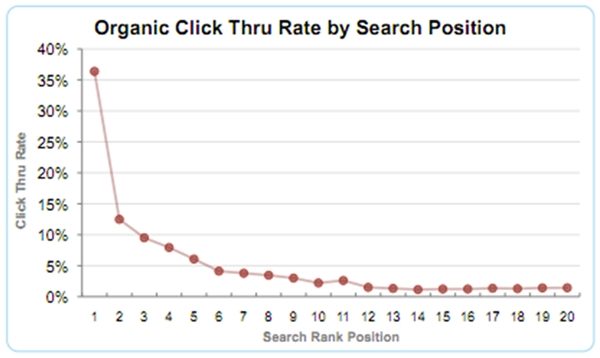
When we first started at Searchreputation.net, a campaign manager for someone running for a seat in the Senate once called me and asked how quickly I can bury the negative stories about a politician "on the10th page of Google." When I told him the amount of labor and man-hours required, I never heard from him again. People overshoot with their expectations because they simply do not know the basic statistics. Our job early on is to explain this simple chart:

That will usually resolve the ROI expectations of the client. In reputation management, if you do not understand the exponential drop and the low incremental return of trying to suppress things beyond page 2, you will not be a good ORM project manager.

Takeaway 7: Link-building know-how is vital

All our suppression projects have an SEO phase. The most critical part of that is building links to assets, but not all assets can support the same link velocity. We use a list of 300+ UGC sites, like Facebook and LinkedIn, that can be pushed up the ranks with a rush of links and some content updates on a weekly basis. But microsites and blogs need special consideration; they must be vetted (especially while Google has them in the sandbox the first six months) by other influential bloggers and news sites; and some .gov and .edu is also important to get these sites to jump out of the gate. Domain names are also still very important: You can take advantage of many new top level domain suffixes, but many reputation management companies have not yet caught on.

Takeaway 8: Look out for "black PR" warfare

Do full audits—in and out of the digital space. That's the hard lesson we learned years ago when we ended up dealing with organized crime syndicates and found ourselves in the middle of a "black PR" war. It was a painful lesson. We now know to probe clients about possible third-party interests who want to undo your work... because it is easy to hire bitcoin-paid mercenaries or hacks to undo ORM efforts. If you do work in an agency, I would strongly advise you to know whom you are really dealing with. What other motives might be out there for wanting these rankings? And if you are commissioning reputation management work, do not outsource it to a third-world jurisdiction.

Some audits reveal counter-parties (those who have an interest in seeing a search result with high prominence stay that way) or a natural obsession with negative results (those who have a morbid curiosity, who go back to search, click on, and engage with an item that you want to suppress from a reputation management standpoint). Google's latest algorithm, called RankBrain, understands that type of behavior and keeps negative results at higher ranks.

The presence of counter-parties, such as disgruntled employees, people with personal vendettas, even unethical competitors, also means you cannot use certain strategies over others. Many clients request a Wikipedia page, for example; however, detection by counter-parties would make that a dangerous strategy. Compounding the problem: if there are credible media sources with negative stories, you should discourage the creation of a Wikipedia page.

Takeaway 9: It's 2017, and crowdsourcing is the difference

Google's RankBrain algorithm knows when you are trying to influence search results, and Google's Chrome browser has made it impossible to source engagement without Google detecting patterns. So, you cannot simply go to Amazon Mechanical Turk or hire microworkers and expect the work you commission to pass Google's filters. (Filters are what make Google's algorithm effective; Google does not process every bit of data.)

So, the way to do crowdsourcing in 2017 is the guerrilla radio way: develop offline techniques that do not leave a digital footprint. There are many options. For example, customer service reps might direct clients over the phone to microsites that have embedded codes that unlock discounts. We use another method to communicate instructions to thousands of private members. (But it may cease to be private if I reveal too much here, so that last item will have to be a tease!)


Source: MarketingProfs