Friday, May 5, 2017

7 ‹Title Tag› Hacks for Increased Rankings + Traffic - Whiteboard Friday

Posted by Cyrus-Shepard

You may find yourself wondering whether the humble title tag still matters in modern SEO. When it comes to your click-through rate, the answer is a resounding yes! In today's Whiteboard Friday, we welcome back our good friend Cyrus Shepard to talk about 7 ways you can revamp your title tags to increase your site traffic and rankings.
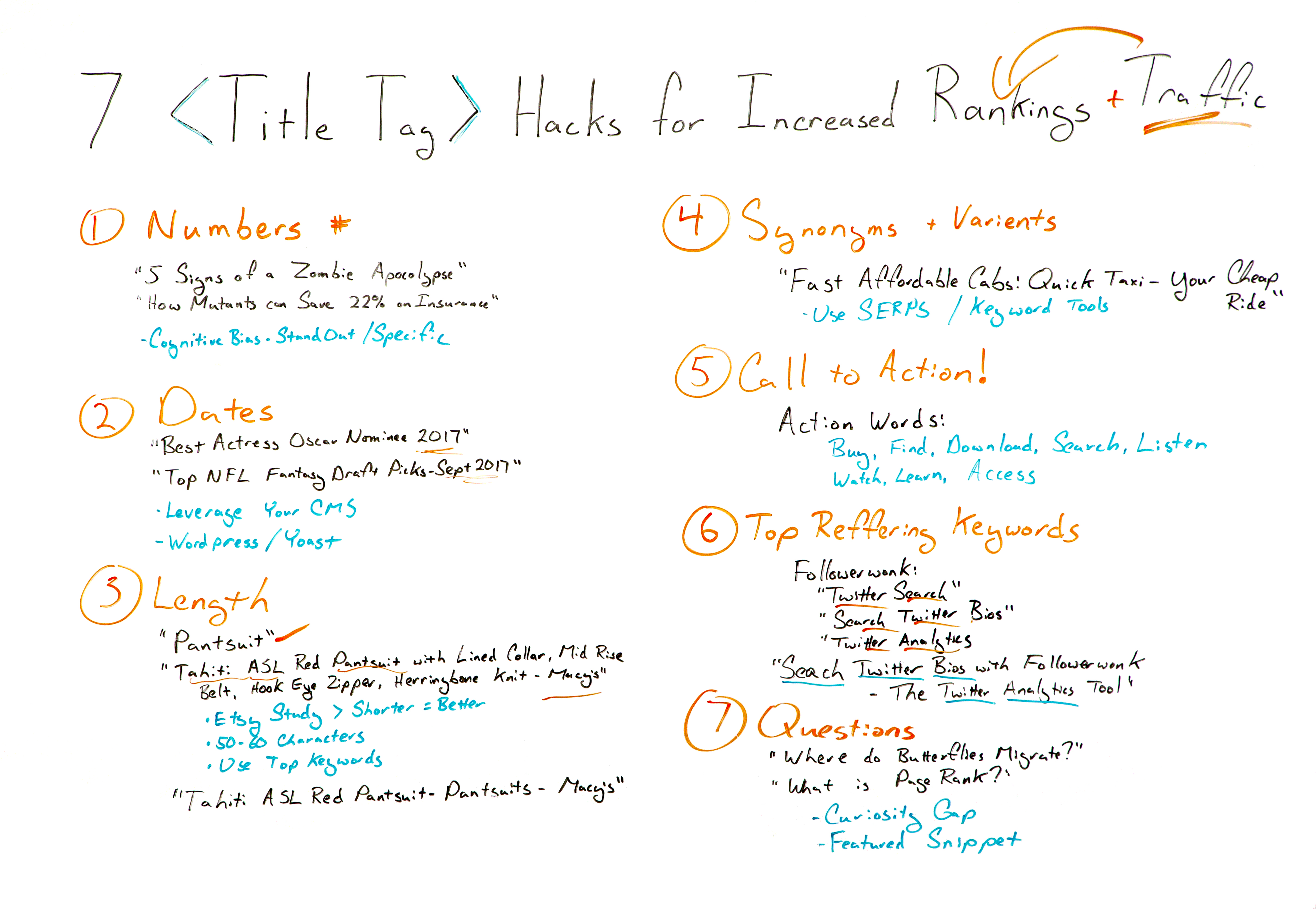
Title tag hacks for increased rankings and traffics

Click on the whiteboard image above to open a high-resolution version in a new tab!

Video Transcription

Howdy, Moz fans. Welcome to another edition of Whiteboard Friday. I'm very excited to be here today. My name is Cyrus. I'm a Moz associate. Today I want to talk you about title tags, specifically title tag hacks to increase your traffic and rankings.

Now, you may be asking yourself, "Are title tags even still important today in SEO?" You bet they are. We've done a lot of correlation studies in the past. Those correlation studies have shown different things sort of decreasing in the past years. But we've also seen a lot of experiments recently where people have changed their title tag and seen a significant, measurable increase in their rankings.

Now, the other aspect of title tags that people sometimes forget about is the click-through rate that you get, which can measurably increase your traffic if you get the title tag right. Now, what's neat about increasing your traffic through click-through rate is we've seen a lot of experiments, Rand has experimented a lot, that if you can increase this, you can measurably increase this.

Traffic through increased clicks can seem to increase your rankings under certain circumstances. So you get the dual benefit. So that's what I want to talk to you about today — increasing those rankings, increasing that traffic by changing the first thing that your visitor is going to see in the SERPs.

So the important thing to remember is that these are things to experiment with. Not all of these hacks are going to work for you. SEO is founded in best practices, but true success is founded when you experiment and try different things. So try some of these out and these will give you an idea of where to get started in some of your title tag experiments.

1. Numbers

Numbers kind of pop out at you. These are examples: "5 Signs of a Zombie Apocalypse" or "How Mutants Can Save 22% on Car Insurance."

  • Cognitive Bias - Standout specific – When you see these in SERPs, they tend to get a slightly higher click-through rate sometimes. This works because of a cognitive bias. Our brains are trained to find things that stand out and are specific. When you're scanning search results, that's a lot of information. So your brain is going to try to find some things that it can grasp on to, and numbers are the ultimate things that are both specific and they stand out. So sometimes, in certain circumstances, you can get a higher click-through rate by using numbers in your title tags.

2. Dates

Rand did an excellent Whiteboard Friday a few weeks ago, we'll link to it below. These are things like "Best Actress Oscar Nominee 2017" or even more specific, you can get the month in there, "Top NFL Fantasy Draft Picks September 2017."

Now, Rand talks about this a lot. He talks about ways of finding dates in your keyword research. The key in that research is when you're using tools like Keyword Explorer or Google AdWords or SEMrush, you have to look for previous years. So if I was searching for this year's, we don't have enough data yet for 2017, so I would look for "Best Actress Oscar Nominee 2016."

  • Leverage your CMS – If you use WordPress, if you use Yoast plugin, you can actually have your title tags update automatically year-to-year or even month-to-month leveraging that. It's not right for all circumstances, but for certain keyword queries it works pretty well.

3. Length

This is one of the most controversial, something that causes the most angst in SEO is when we're doing audits or looking at title tags. Inevitably, when you're doing an SEO audit, you find two things. You find title tags that are way too short, "Pantsuit," or title tags that are way, way, way too long because they just want to stuff every keyword in there, "Tahiti ASL Red Pantsuit with Line Color, Midrise Belt, Hook-eye Zipper, Herringbone Knit at Macy's."

Now, these two, they're great title tags, but there are two problems with this. This is way too broad. "Pantsuit" could be anything. This title tag is way too diluted. It's hard to really know what that is about. You're trying to scan it. You're trying to read it. Search engines are going to look at it the same way. Is this about a pantsuit? Is it about herringbone knit? It's kind of hard.

  • Etsy study – So Etsy recently did a study where Etsy measured hundreds of thousands of URLs and they shortened their title tags, because, more often than not, the longer title tag is a problem. Shorter title tags, not so much. You see longer title tags in the wild more often. When they shortened the title tags, they saw a measurable increase in rankings.
  • 50–60 Characters – This is one of those things where best practices usually is the best way to go because the optimal length is usually 50 to 60 characters.
  • Use top keywords – When you're deciding what keywords to put it when you're shortening this, that's where you want to use your keyword research and find the keywords that your visitors are actually using.

So if I go into my Analytics or Google Search Console, I can see that people are actually searching for "pantsuit," "Macy's," and maybe something like that. I can come up with a title tag that fits within those parameters, "Tahiti ASL Red Pantsuit," "pantsuits" the category, "Macy's." That's going to be your winning title tag and you'll probably see an increase in rankings.

4. Synonyms and variants

Now, you'll notice in this last title tag, the category was a plural of pantsuit. That can actually help in some circumstances. But it's important to realize that how you think your searchers are searching may not be how they're actually searching.

Let's say you do your keyword research and your top keywords are "cheap taxis." You want to optimize for cheap taxis. Well, people may be looking for that in different ways. They may be looking for "affordable cabs" or "low cost" or "cheap Ubers," things like that.

So you want to use those variants, find out what the synonyms and variants are and incorporate those into your title tag. So my title tag might be "Fast Affordable Cabs, Quick Taxi, Your Cheap Ride." That's optimized for like three different things within that 50 to 60 word limit, and it's going to hit all those variants and you can actually rank a little higher for using that.

  • Use SERPs/keyword tools – The way you find these synonyms and variants, you can certainly look in the SERPs. Type your keyword into the SERPs, into Google and see what they highlight bold in the search results. That will often give you the variants that people are looking for, that people also ask at the bottom of the page. Your favorite keyword tool, such as Keyword Explorer or SEMrush or whatever you choose and also your Analytics. Google Search Console is a great source of information for these synonyms and variants.

5. Call to action

Now, you won't often find the call-to-action words in your keyword research, but they really help people click. These are action verbs.

  • Action words — buy, find download, search, listen, watch, learn, and access. When you use these, they give a little bit more excitement because they indicate that the user will be able to do something beyond the keyword. So they're not necessarily typing it in the search box. When they see it in results, it can create, "Oh wow, I get to download something." It provides a little something extra, and you can increase your click-through rates that way.

6. Top referring keywords

This is a little overlooked, and it's sort of an advanced concept. Oftentimes we optimize our page for one set of keywords, but the traffic that comes to it is another set of keywords. But what's very powerful is when people type their words into the search box and they see those exact same words in the title tags, that's going to increase your click-through rate.

For an example, I went into the analytics here at Moz and I looked at Followerwonk. I found the top referring keywords in Google Search Console are "Twitter search," "search Twitter bios," and "Twitter analytics." Those are how people or what people are looking for right before they click on the Followerwonk listing in Google.

So using that information, I might write a title tag like "Search Twitter Bios with Followerwonk, the Twitter Analytics Tool." That's a pretty good title tag. I'm kind of proud of that. But you can see it hits all my major keywords that people are using. So when I type in "Twitter analytics" into the search box and I see "The Twitter Analytics Tool," I'm more likely to click on that.

So I've written about this before, but it's very important to optimize your page, not only for the traffic you're trying to get, but the traffic you're actually receiving. When you can marry those two, you can be stronger in all aspects.

7. Questions

Questions are great tools to use in your title tags. These are things like, "Where Do Butterflies Migrate?" Maybe your keyword is just "butterflies migrate." But by asking a question, you create a curiosity gap, and you give people an incentive to click. Or "What is PageRank?" That's something we do here at Moz. So you get the curiosity gap.

But oftentimes, by asking a question, you get the bonus of winning a featured snippet. Britney Muller wrote an awesome, awesome post about this a while back about questions people also ask, how to find those in your keyword research and claim those featured snippets and claim "people also ask" boxes. It's a great, great way to increase your traffic.

So these are seven tips. Let us know your tips for title tags in the comments below. If you like this video, I'd appreciate a thumbs up. Share it with your friends on social media. I'll see you next time. Thanks, everybody.

Video transcription by Speechpad.com


Sign up for The Moz Top 10, a semimonthly mailer updating you on the top ten hottest pieces of SEO news, tips, and rad links uncovered by the Moz team. Think of it as your exclusive digest of stuff you don't have time to hunt down but want to read!


Source: Moz Blog

Thursday, May 4, 2017

If You're Attending MozCon 2017, You Should Definitely Pitch to be an Ignite Speaker

Posted by ronell-smith

Are you a good storyteller, able to hold a crowd at rapt attention for minutes at a time? Do you have a story you're bursting at the seams to share?

Well, ye olde yarn-spinner, a MozCon Ignite talk sounds like just the thing for you.

The five-minute talks have become quite a hit since being introduced in 2015, with talks leaving folks with belly aches from laughter or tears from personal heartache — and everything in between.

If you have an enticing story in you just waiting for an outlet, we'll supply the audience.

The MozCon 2017 Ignite talks — one of the signature networking events — take place Tuesday, July 18.

Buy your MozCon 2017 ticket!


Why should you care about Ignite talks?

Often called "lightning talks" for their emphasis on brevity, Ignite-style talks are five minutes in length and feature slides that automatically advance.

The short stories can pack a powerful punch, however, as anyone who saw Michael Cottam's 2016 Ignite talk can attest:

One attendee penned a heartfelt account of how Michael's talk helped him reprioritize his life — it's well-worth a good read. Make sure you have a tissue handy.


You can share your story, too, in 2017. There will be 10 speaking slots.

The only rule we have governing stories told during an Ignite talk is that they cannot relate to online marketing or feature anything resembling career advice.

This is your chance to show some personality.

Take a look at the topics covered from 2016:

  • Help! I Can't Stop Sweating – Hyperhidrosis, by Adam Melson
  • Life Lessons Learned as a Special Needs Parent, by Adrian Vender
  • How Pieces of Paper Can Change Lives, by Anneke Kurt Godlewski
  • Prison and a Girl that Loves Puppies, by Caitlin Boroden
  • Embracing Fear, Potential Failure, and Plain Ol' Discomfort, by Daisy Quaker
  • A Plane Hacker's Guide to Cheap *Luxury* Travel, by Ed Fry
  • Embracing Awkward: The Tale of a 5' 10" 6th Grader, by Hannah Cooley
  • Hornets, Soba, & Friends: A Race in Japan, by Kevin Smythe
  • Wooly Bits: Exploring the Binary of Yarn, by Lindsay Dayton LaShell
  • Finding Myself in Fiction: LGBTQUIA Stories, by Lisa Hunt
  • Is Your Family Time for Sale? by Michael Cottam
  • How to Start an Underground Restaurant in Your Home, by Nadya Khoja
  • Flood Survival: Lessons from the Streets of ATL, by Sarah Lively
  • How a Cartoon Saved My Life, by Steve Hammer

And, lucky for us all, Geraldine DeRuiter, aka the Everywhereist, will be back as emcee for the third time in as many years.


The deets: How to pitch for an Ignite talk

  • Simply fill out the form below — you're limited to one submission
  • Talks cannot be about online marketing or career-focused
  • Current MozCon speakers are not able to pitch
  • Previous MozCon Ignite presenters are not eligible
  • Submissions close on Sunday, May 14 at 5pm PDT
  • Selections will be made by early June
  • All presentations are expected to follow the MozCon Code of Conduct
  • You must attend MozCon, July 17–19, and be present Tuesday night in person

If selected, you'll receive...

  • Five minutes onstage, Tuesday night at McCaw Hall. (The event lasts from 7–10pm.)
  • $300 off the regular-priced ticket to MozCon (If you've already purchased a ticket, we'll refund you $300 for a regular-priced ticket or $100 for an early-bird ticket. Discounts are not offered for super-early-bird tickets.)
  • Help crafting a winning talk
  • Stage tour of the event space between 5–7pm Tuesday night in advance of the event

Unfortunately, we do not cover travel and/or lodging for MozCon Ignite speaking slots.

What makes a great pitch?

  • A story that's compelling and that can be told in the allotted timeframe
  • Sharing a topic you're passionate about and able to succinctly share what makes it so great.
  • Follow the guidelines. Yes, the word counts are limited on purpose. (Do not submit links to Google Docs or other resources. Multiple submissions will result in immediate disqualification.)

****Include links to any videos of you speaking publicly.

If you'd like to see what an Ignite-style talk looks like, check out these videos from Ignite Seattle 30.

Most importantly, get to work on submitting that pitch to grace the stage yourself at MozCon 2017.


Sign up for The Moz Top 10, a semimonthly mailer updating you on the top ten hottest pieces of SEO news, tips, and rad links uncovered by the Moz team. Think of it as your exclusive digest of stuff you don't have time to hunt down but want to read!


Source: Moz Blog

How Small Digital Publishers Can Grow Their Network and Save Time

Posted by lydiagilbertson

Being a small or startup publishing company is hard. The digital advertising industry is broken. Larger companies like Vox and Buzzfeed are some of the only online publications that can hope to monetize their content effectively. Smaller niche publications often have an even harder time attracting return visitors or getting people outside of their current active users to see their content at all. Already at a disadvantage, most small publications are also understaffed and underfunded. These publications can use content marketing and search marketing concepts within their online distribution strategy to better reach their audiences and to compete with bigger publications.

Platforms as distributors

Somehow, platforms have long been both the saviors and the destroyers of the digital publishing industry. Regardless, they've become a necessary evil for the content distribution strategy of almost all online publishing companies. There's no real harm in trying out different ways to reach your audience, but don’t waste your time on a platform that isn’t growing your audience or enhancing its engagement. The usual contenders being Facebook and Twitter, there are a few more platforms that can be easily utilized towards helping you to reach your audience.

1. AMP

Google’s Accelerated Mobile Page (AMP) project is a complex attempt by Google to make pages load faster on mobile devices, keep users on their platform, and to better engage with the publishing community. Many larger sites report a lot of success using AMP. Smaller publishers may be wary of trying out AMP on their sites, out of fear that it will further overwork their staff or that it requires an intense amount of web development knowledge. However, Google AMP is fairly simple to implement (more on how further down the page) if you're using WordPress or another common content management system.

Companies using WordPress will have an especially easy time adding AMP to the list of ways they distribute their content. Both WordPress and Yoast have plugins available to put (and manage) your content into the AMP format. Medium is also in the process of allowing its users an easy way to designate AMP content. Here are a few things to keep in mind before publishing your content via AMP:

  1. Make sure it’s in article format. AMP is meant for blog posts and news articles, so don't try to publish products or landing pages using Google AMP.
  2. Be conscious of the audience you're publishing for when using AMP. Articles that appear in the Google AMP carousel in the SERP are usually topical and considered “news.”
  3. If your site is struggling with speed issues, AMP could be a part (but not all) of the solution, as it will help your articles load more quickly on mobile devices.
  4. If your site doesn't use WordPress, implementing AMP might be a little bit harder than just downloading a plugin for your CMS. Find more out about that process here.
  5. Analytics tracking should be included in your overall traffic and segmented to show how much traffic comes from AMP. Find out more about AMP and Google Analytics here.

2. Medium

Medium is another platform that can help more users to see your content and stay on the page long enough to read it. Like any platform, hosting your entire site on Medium comes with the risk of giving your content to another entity rather than your own website. This is a concern because hosting all of your content somewhere like Medium means it could make changes to the platform that you may not like, or in severe situations shut down entirely (and take your content with it). It also has limited capabilities with on-page ads. However, there are some larger publishers that have been adopting Medium as their main source of content distribution. There are several benefits to doing this:

  1. Medium has a built-in audience of millions of engaged readers.
  2. Most of the content on Medium is high quality.
  3. Migrating your entire site to the Medium platform is actually relatively easy for both WordPress and non-WordPress sites. Be sure to keep in mind that hosting all of your content on a platform can be risky.

Another way to utilize Medium’s built-in audience is to republish your content onto the platform. Medium allows for its users to write content on their platform and then canonicalize to their own website (that's not on Medium). This allows small publishers to pick which content goes on Medium (much like a social media platform) in order to make sure it's targeted to Medium’s user-base.

3. Google News

Google News is a section of the search engine results page that focuses entirely on timely news content. In order for many websites to be featured in this specialized SERP, they have to go through the application process and get accepted into the Google News program. After acceptance, the site has to follow and keep a specific set of meta tags up-to-date, only posting timely content designated for the platform. Find out more about how to get accepted into Google News here.

Utilize content marketing tools

Outside of monetization, the number-one hurdle that most small publishing companies face is being understaffed and overworked. One way to remedy this is using tools that help diminish the workload involved in managing content-heavy sites. Here are a list of tools that can help small publishers cut down on their tasks:

1. CoSchedule

CoSchedule is editorial calendar software that minimizes time spent keeping track of all of the posts you want/need to do on any given day. It’s designed for both small and enterprise companies, but is better suited for smaller ones due to its all-in-one approach. CoSchedule allows you to plan your posts in advance and set a time for when to post them on social media platforms, all in a single tool.

2. BuzzSumo

Ideating different pieces of content for your site takes a significant amount of time. Utilizing a tool like BuzzSumo could help you to come up with a ton of different article concepts based on what’s trending on different social media platforms.

3. Canva

Having a small team usually means that your graphic designer is extremely busy (or nonexistent). Making quick graphics and supplementary images for your posts can totally be done utilizing Canva, without bogging down your graphics team with more work than it can handle (plus, there’s a free version).

Focus on your niche

Find your niche and build your audience. Obviously, this is easier said than done. But, it’s extremely important as a small publisher to be filling a void or taking a different perspective in the already overflowing content funnel of the Internet. Find your unique voice and the people that want to hear it. Sticking to your publication's brand or niche will in turn build you a specialized audience. This allows prospective advertisers to better target and then convert using your content.

Don’t always focus on quantity, but quality

Similar to the last point, in addition to not overstretching your genre, don’t overstretch your posting frequency. Rather than posting more times per day just to meet an imaginary quota, it’s better to create fewer posts of higher quality. Moz did a publishing experiment that illustrates the complexity of publishing frequency and content quality. Pay more attention to what your users want rather than what you assume Google does.

Summary

Being a small publishing company is hard. Most small publications find themselves understaffed and overworked trying to catch up with much larger companies.The best way to try to compete with larger publishing companies is to keep your focus small and to use external applications. They'll help you save time and make creating easier. Utilize all of the platforms that work for your audience — not just all of the platforms available.


Sign up for The Moz Top 10, a semimonthly mailer updating you on the top ten hottest pieces of SEO news, tips, and rad links uncovered by the Moz team. Think of it as your exclusive digest of stuff you don't have time to hunt down but want to read!


Source: Moz Blog

Wednesday, May 3, 2017

Offline & Organic: The Two Rivers That Feed Modern Local SEO

Posted by MiriamEllis

tworivers2.jpg

The craft that is your business navigates the local waterways. Whether yours is an independently owned natural foods store or a medical enterprise with hundreds of locations, it can be easy to get lost cresting all of the little waves that hit our industry, week by week, year after year.

Google endorses review kiosks and then outlaws them. They pop your dental practice into a carousel and then disband this whole display for your industry. You need to be schema-encoded, socially active, mobile-friendly, voice-ready… it’s a lot to take in. So let’s weigh anchor for a few minutes, in the midst of these never-ending eddies, to evaluate whether all of the developments of the past few years add up to a disjointed jumble of events or represent a genuine sea change in our industry. Let’s see which way the wind is really blowing in local search marketing.

The organic SEO journey is now our own

If you’ve only been working in SEO for a couple of years, you may think I’m telling you a fishy yarn when I say there was a time not long ago when this otherwise brilliant industry was swamped with forum discussions about how much you could move the ranking needle by listing 300 terms in a meta keywords tag, putting hidden text on website pages, buying 5,000 links from directories that never saw the light of day in the SERPs and praying to the idol of PageRank.

I’m not kidding — it was really like this, but even back then, the best in the business were arguing against building a marketing strategy largely based on exploiting search engines’ weaknesses or by pinning your brand to iffy, spammy or obsolete practices. The discourse surrounding early SEO was certainly lively!

Then came Panda, Penguin, and all of the other updates that not only targeted poor SEO practices, but more importantly, established a teaching model from which all digital marketers could learn to visualize Google’s interpretation of relevance. There were many updates before these big ones, but I mention them because, along with Hummingbird, they combine to set much of the stage for where the SEO industry is at today, after 17 years of signals from Google schooling us in their worldview of search. If I could sum up what Google has taught us in 3 points, they would be:

  1. Market to humans, and let that rule how you write, earn links, design pages and otherwise promote your business
  2. Have a technician handy to avoid technical missteps that thwart growth
  3. Your brand will live or die by the total reputation it builds, both in terms of search engines and the public

Most of what I see being written across the SEO industry today relates to these three concepts which form a really sane picture of a modern marketing discipline — a far cry from stuffed footers and doorway pages, right? Yes, I’m still getting emails promising me #1 Google rankings, but by and large, it’s been inspirational watching the SEO industry evolve to earn a serious place in the wide world of marketing.

Now, how does all this relate to local SEO?

There are two obvious reasons why the traditional SEO industry’s journey relates to our own:

  1. Organic strength impacts local rankings
  2. Local businesses need organic (sometimes called local-organic) rankings, too

This means that for our agencies’ clients, we’ve got to deliver the goods just the way an organic SEO company would. I’d bet a nickel there isn’t a week that goes by that you don’t find yourself explaining to an SAB owner that you’re unlikely to earn him local rankings for his service cities where he lacks a physical location, but you are going to get him every bit of organic visibility you can via his website’s service city landing pages and supporting marketing. And for your brick-and-mortar clients, you are filling the first few pages of Google with both company website and third-party content that creates the consumer picture we call “reputation.”

It’s organic SEO that populates your clients’ most important organic search results with the data that speak most highly of them, even if this SEO is being done by Yelp or TripAdvisor. Because of this, I advocate studying the history of Google’s updates and how it has impacted the organic SEO community’s understanding of Google’s increasingly obvious emphasis on trust and relevance.

And, I will go one further than this. You are going to need real SEO tools to manage the local search marketing for your clients in the most competitive geo-industries. Consider that with the release of the Local Search Ranking Factors 2017 study, experts have cited that:

  • 5 of the top 20 local pack/finder factors relate to links
  • Quality/authority of inbound links to domain was chosen as the #1 local-organic ranking factor.

Add to this the top placement of factors like domain authority of website and the varieties of appropriate keyword usage.

In other words, for your client who owns a bakery in rural Iowa, you’ll likely need basic organic SEO skills to get them all the visibility they need, but for your attorney in Los Angeles, your statewide medical practice and your national restaurant chain with 600 locations, having organic SEO tools at the professional level of something like Moz Pro in your marketing kit is what will enable you to grab that competitive edge your bigger clients absolutely have to have, and to hold onto it for them over time.

The organic river is definitely feeding the local one, and your ability to evaluate links, analyze SERPs, and professionally optimize pages is part of your journey now.

The offline PR journey is now our own

I sometimes wonder if my fellow local SEOs feel humbled, as I do, when talking to local business owners who have been doing their own marketing for 20, 30, or even 40 years. Pre-Internet, these laudable survivors have been responsible for deciding everything from how to decorate the storefront for a Memorial Day sale, to mastering customer service, to squeezing ROI instead of bankruptcy out of advertising in newspapers, phone directories, coupon books, radio, billboards and local TV. I call to mind the owner of a family business I consulted with who even sang his own jingle in an effort to build his local brand in his community. Small business owners, in particular, really put it all on the line in their consumer appeals, because their survival is at stake.

By contrast, our local SEO industry is still taking baby steps on a path forged by the likes of Wayside Inn (est. 1797), Macy’s (est. 1858), and the Fuller Brush Man, (est. 1906). These stalwarts of selling to local consumers have seen it all (and tried much of it) in the search for visibility, from Burma-Shave billboards to “crazy” local car dealer ads.

In the 1960’s, Pillsbury VP Robert Keith published an anecdotal article which promoted, in part, a consumer-centric model for marketing, and though his work has been criticized, some of his concepts resemble the mindset we see being espoused by today’s best marketers.

Very often, being consumer-centric is nearly analogous to being honest. Just as the organic SEO world has been taught by Google that “tricking” Internet users and search engines with inauthentic signals doesn’t pay off in the long run, making false claims on your offline packaging or TV ads is likely to be quickly caught and widely publicized to consumers in the digital age. If your tacos don’t really contain seasoned beef, your 12-packs of soda aren’t really priced at $3.00, and your chewing gum doesn’t really kill germs, can your brand stand the backlash when these deceptions are debunked?

And even for famous brands like Macy’s that have successfully served the public for decades, the simple failure to continuously create an engaging in-store experience or to compete adeptly in a changing market can contribute to serious losses, including store closures. Offline marketing is truly tough.

And, how does all this relate to local SEO?

tworivers3.jpg

Yes, the “three grumpy woman” price gouging and doing “the dodgy”, the desk clerk who screams when asked about wi-fi, and the unmanaged but widely publicized wrong hours of operation — they say local business owners fear negative reviews, but local SEOs are the ones who walk into these situations with incoming clients and say, “My gosh, just what have these people been doing? How do I fix this?”

The forces of organic SEO (high visibility) and offline marketing (consumer-centricity) face off on our playing field, and often, the first intimation we get of our clients’ management of the in-store experience comes from reading the online reputation they’ve built on the first few pages of Google. Sometimes we applaud what we discover, sometimes we quake in our boots. It’s become increasingly apparent that, as local SEOs, we aren’t just going to be able to concentrate on optimizing title tags or managing citations, because the offline world we work to build the online mirror image of will reflect all of the following attributes pertaining to our clients:

  • Consumer guarantee policies
  • Staff hiring and training practices
  • Cleanliness
  • Quality
  • Pricing
  • Convenience
  • Perception of fairness/honesty
  • Personality of owner/management/staff

This list has nothing to do with online technical work, but everything to do with the company culture of the businesses we serve.

Because of this, local SEOs who lack a basic understanding of how customer service works in the offline world won’t be fully equipped to consult with clients who may need as much help defining the USP of their business as they do managing its local promotion. Predominantly, we work remotely and can’t walk into our client’s hotel or medical practice. We glean clues from what we see online (just like consumers) and if we can build our knowledge of the history of traditional marketing, we’ll have more authority to bring to consultations that address in-store problems in honest, gutsy ways while also maximizing overlooked opportunities.

I once walked into a small, quaint bakery selling dainty little cakes and expensive beverages, decorated in a cozy floral scheme; a place my auntie might have liked to take tea with a friend. The in-store music in this haven of ladylike repose? Heavy metal so loud it hurt my ears, despite being popular with the two kids left to man the shop while the owner was nowhere in evidence. The place was gone within a year.

As local SEOs, we can’t fix owners who aren’t determined to succeed, but our study of traditional marketing principles and consumer behavior can help us integrate the offline stream into the local, online one, making us better advisors. Likely you are already teaching the art of the offline review-ask. Whether your agency builds on this to begin managing billboards and print mailers directly for clients, or you are only in on meetings about these forms of outreach, the more you know, the better your chances at running successful campaigns.

It’s all local now, plus....

In communities across the US, townsfolk have long carried out the tradition of gathering on sidewalks for the pageantry of the annual parade in which the hallmarks of local life stream by them in procession. Local school marching bands, the hardware store’s float made entirely out of gardening tools, the church group in homemade Biblical costumes, the animal shelter with dogs in tow, and the Moose Club riding in an open car, waving to the crowd.

This is where we step in, leading the the local parade to march it past the eyes of digital consumers. We bring the NAP, citations, locally optimized content and review management into the stream, teaching clients how to be noticed by the crowd. And, we do this on the shoulders of the organic SEO and offline marketing communities’ constantly improving sense of the importance of truth in advertising.

In other words, everything that is offline, everything that is organic is now our own. We are simply adding the digital location data layer and a clear sense of direction to bring it all together. And, just to clarify, it’s not that the organic and offline streams weren’t feeding our particular river in the past — they always have been. It’s just that it has become increasingly obvious that a multi-disciplinary understanding does really belong to the work we do as local SEOs.

Manning a yare local SEO boat & charting a savvy course for the future

In the lingo of old salts at sea, a “yare” ship is one that is that is quick, agile and lively, and that’s exactly what your business or agency needs to be to handle the small but constant changes that impact the local SEO industry.

From the annals of local SEO history, you can find record after record of some of the top practitioners stating after each new update, filter or guideline change that their clients were only minorly affected instead of sunk deep. How do they achieve this enviable position? I’ve concluded that it’s because they have:

  1. Become expert at seeing the holistic picture of marketing
  2. Base their practices on this, sticking to basic guidelines and seeing human connections as the end goal of all marketing efforts

It’s by building up a sturdy base of intelligent, homocentric marketing materials (website, citations, social contributions, in-store, print, radio, etc.) that businesses can stand firm when there’s a slight change in the weather. It doesn’t matter whether Google hides or shows review stars, hammers down on thin content or on suspicious links because the bulk of the efforts being made by the business and its marketers aren’t tied to the minutiae of search engines’ whims — they’re tied to consumers.

It’s because of this dedicated consumer tie that enough that is good has been built to protect the business against massive losses with each new update or rule. Even a few bad reviews are really no problem. Consumers are still finding the business. Revenue is still coming in. Because of this sturdy base, the business can be yare, making quick, agile adjustments to fix problems and maximize the benefits of new opportunities which arise with each small change, rather than having to bail themselves out on a ship that has been sunk due to lack of broader marketing vision.

Let’s sum it up by saying that to chart a good course for future success, your company must know the technical aspects and historical tenets of local, organic, and offline marketing — but above all else, you must know consumers and have a business heart dedicated to their service. A mature heart is one that wisely balances the needs of self with the needs of others. I, for one, find my own heart all-in participating in this exciting and necessary maturation of our industry.


Sign up for The Moz Top 10, a semimonthly mailer updating you on the top ten hottest pieces of SEO news, tips, and rad links uncovered by the Moz team. Think of it as your exclusive digest of stuff you don't have time to hunt down but want to read!


Source: Moz Blog

Tuesday, May 2, 2017

The Site Speed and SEO Connection

From ProBlogger SEO expert Jim Stewart of Bloggers SEO

Last year the Australian retailer Booktopia gave a presentation where they shared that speeding up their page load times by 1 second, equated to an extra $600,000 on the bottom line.

Today, speed matters. Turning your blog into a highly optimised, relevant, platform takes time. Fortunately, SEO has shortened the distance between blog owner and reader. In 2017, users will ‘reject’ websites that don’t stack up, speed-wise. While acceptable load page times range from .5 seconds to four seconds, most support a 1.5-second load time for continuous success.

Today’s top 20 websites have lead times under this at less than one second, and they’re only getting faster. So, how can you make your site rank higher, perform faster, and remain popular? SEO, still, is the answer. It’s also an incredibly reliable one.

Speed and SEO: What’s the Connection?

The Googlebot crawls sites independently, judging their worth based upon several factors. Of these factors, site speed is the easiest to control. Speed, itself, is derived from the time it takes between site clicks and views. If your website is fully optimised, it’ll take only half of a second to load. Google research suggests that pages can lose as much as 40 percent of traffic when they take over three seconds to load; a powerful SEO option is unbeatable. Simply put; you need to clear your database—and often. Having a fast database will speed up the site. There are many quality WordPress database cleaners available. I recommend the rvg database optimiser plugin that is a simple ‘One-click’ WordPress database cleaner and optimiser that assists you in crucial tasks such as deleting old posts, optimising database tables, and creating optional log-files.

How Can You Measure Speed?

Because speed is an all-important website factor, it’s important to check it often. You can use Google PageSpeed Insights, entering your page’s URL to check its response speed. Once it’s been analysed, you’ll be presented with a page report. This report assesses your page and delivers a rating out of 100, taking into account factors such as user experience, and makes suggestions for faster speeds. Each recommendation is clickable, linking you to additional advice. You can also use Google Search Console’s Crawl Stats report. Under crawl stats, you will see a green line graph. This is the average speed it takes the Googlebot to download a page. Try to get this under an average of 500ms.

Further Optimisation

Once you have your SEO plan, optimised the database, and have created a speed benchmark, you should further boost your site’s speed by making sure you have a good workflow for optimising images. So many blogs upload huge images when they don’t need to. Make sure the images you upload have a resolution no larger than what they need to be displayed. I have seen thumbnail images on a webpage that were huge files just because they were not re-sized before upload. With images, you can also use compression plugins such as WP Smush that will compress the files once you have uploaded them.

Render Blocking

When you use PageSpeed Insights, you’ll most likely see a reference to “render-blocking.” This is referring to code that is stopping the page from rendering until it has been executed. Usually JavaScript but CSS as well. Often these can be moved in the code, say to the footer, so that the user gets to see the page quickly and then the JavaScript does its thing in the background.

Hosting

There are many ways of optimising your page’s speed. That said, few come close to the power of hosting your WordPress site with WP Engine. They offer today’s best-in-class customer service, which is vital to website upkeep. WP Engine is built on EverCache, an architecture that creates reliable, scalable sites. Remember: Your site’s visitors are an impatient bunch. If your site loads slowly, they’ll seek business elsewhere. The EverCache platform helps sites run up to six times faster, using effective front-end technology. All WP Engine users benefit from the enterprise-grade software capable of continuously improving a website.

A Step Above the Rest

Note: We’re hearing a lot of very good things about WPEngine if you’re looking for hosting of an established site with more traffic (or want to position yourself for that in the future). They are more expensive but, as WordPress specialists, they are doing some great things for bloggers. Use ProBlogger's partner link and you’ll get 2 months free when you sign up for an annual plan.

WP Engine is also designed for completely scalable WordPress hosting. Its proprietary, front-end build operates upon a slew of carefully designed rules. Each rule is continuously checked for maximum performance, so you don’t need to worry about outdated solutions. Offering one of the best caching mechanisms available, WP Engine also reduces server load. Really, it’s a win-win situation in terms of boosting speed. By being instantly accessible while handling high concurrent traffic numbers, WP Engine isn’t only one of the fastest-working options around—it’s one of the most reliable.

At the end of the day, your website’s speed will determine its memorability, popularity, and use. Forty seven percent of consumers, in fact, expect a web page to load in under two seconds.

The post The Site Speed and SEO Connection appeared first on ProBlogger.


Source: ProBlogger

The Homepage is Dead: A Story of Website Personalization

Posted by cara.harshman

In 1998, Jeff Bezos had a vision for the Internet. At that time he was four years into building Amazon. It was taking off as a humongous online emporium of books and music. In an interview with the Washington Post that year, Bezos made a visionary statement about the web. “If we have 4.5 million customers, we shouldn’t have one store. We should have 4.5 million stores,” he said.

Fast-forward 19 years and here we are in 2017. My Amazon homepage is extremely personalized to me. (In August it was showing me glow sticks and solar-powered lamps. It clearly knew I was going to Burning Man.)

Bezos’ vision is reality for Amazon.com and many more e-commerce sites. At this point, personalized product recommendations are table stakes for online retail. But we haven’t seen personalization become as popular across the rest of the non-retail web. Most businesses have one version of the homepage that is supposed to cater to all different sorts of people. The sites still say, “come one, come all!”

This is troubling. Marketers spend so much time and energy developing personas and messaging for the myriad audiences we want to turn into customers. But it usually stops there. It’s time we start extending this persona-driven, personalized marketing to our websites, and specifically the homepage. The homepage is the proverbial front door of our brands; often a landing page, it’s the first page you’ll go to find out who a company is and what it does.

As marketers, it’s our job to crack open the black box on how to do things that may seem like a mystery. SEO? Moz takes care of that one. Website personalization is another one of those mysteries. What are the problems you need to work through to get it done? How much does it cost? How valuable is it?

I want to help bust open that black box by sharing first-hand experience personalizing Optimizely.com. In my time on the marketing team there, we redesigned the homepage. We went from one average best homepage to 26 different versions of the homepage uniquely personalized to different visitors. Let’s talk about why we did it, what we did, and how it all performed (because of course we measured it).

The average best version of our homepage.

Homepage personalized for visitors from Target.

Homepage personalized for visitors from the travel industry.

Homepage personalized for visitors browsing optimizely.com late night.

Homepage personalized for visitors from Microsoft.

Why invest in website personalization?

We redesigned and personalized the homepage for three reasons:

  1. To get closer to a global maximum. We had reached a local maximum on our current site. After four years of iteration and conversion optimization, we had achieved the best possible version of the existing design. New A/B tests on the page returned insignificant results. We had to design a radically different site to get closer to the global maximum with higher conversion rates and engagement. In other words, we were climbing a mountain and had reached a small hill, but our goal was to summit the peak.
  2. To increase lead quality. Our existing homepage was filling the sales funnel with lots of not-so-great leads. Often, people wound up in a conversation with a sales-human who were not sufficiently educated about what Optimizely had to offer. Not a good situation for the lead or the sales-human. We had to redesign the experience so that folks understood our value.
  3. To support account-based marketing (ABM). ABM is an approach to marketing and selling that deliberately aligns sales and marketing around a list of important accounts and delivers targeted campaigns to engage those accounts. The goal is to be highly intentional with who you sell to and nurturing those interactions with personalized content. This personalization campaign was intended to drive engagement with our target accounts.

What to personalize and for whom?

After knowing why we were personalizing, the next question becomes what are we personalizing and for whom? The “for whom” part of this question was our starting place. It’s the best starting point for any personalization campaign. You must define your audience (aka who you’re personalizing for) before you decide on the experience (aka what you’re going to show them).

Defining your audiences takes time and is a worthy investment because it’s the foundation of the campaign. We came up with a few traits for what makes a “good” audience:

  • It should be identifiable. You should have a way to technically identify the thing that makes a visitor part of a specific audience.
  • It should be valuable. Measured either in volume or strategic importance, the audiences should be worth something. Because of our account based marketing approach, some of our audiences consist of one company, but that company has humongous value to us.
  • It should be differentiated enough to receive unique experiences. Your audiences should be distinguished enough to receive a unique experience.

With those traits in mind, you can define audiences across two axes: behavioral/what a visitor does and demographic/who a visitor is.

For our homepage campaign we chose to create unique experiences for these audiences:

  • Named accounts: Current and prospective customers that are part of a target account list. We defined this by uploading a list into Optimizely and using Demandbase to identify the IP address of visitors coming from those companies.
  • Industries: Visitors from target verticals which have strong use cases for A/B testing and personalization. We used Demandbase data for this as well, and CRM data.
  • Geography: Is the visitor from North America or Europe or APAC and so on. For geography we used Optimizely targeting abilities.
  • Customers: Visitors who are known Optimizely customers. We defined customers by identifying visitors who had an Optimizely login cookie on their browser.

2016-02-03 12.08.22.jpgA wireframe drawing of the new site with ample space for personalized content.

  • Engaged visitors: Return visitors who have engaged with one or more of Optimizely’s digital properties in the past (blog, website, community, knowledge base, etc.). We executed this with behavioral targeting through Optimizely.

Once you have audiences defined — and don’t be surprised if this takes a while — you are ready to dissect your page and identify the places you want to personalize.

Sidenote: We had to redesign the homepage in order to make space for content that could be personalized. Take a look at the original site; you can see that there’s hardly anything on the page, no content to personalize! In order to do website personalization, you need ample real estate to create personalized experiences.

How did personalization perform?

This personalization campaign was, importantly, an A/B test: 50% of homepage visitors saw the old version, and 50% saw a personalized one. Personalization is a hypothesis like any other design/functionality change and should be treated with similar rigor as A/B testing. You want to know that the personalization is improving the experience/conversion rate/metrics, not decreasing them.

Here’s the A and B:

In the test we measured lead conversion rate, accounts created, lead qualification rate, and softer anecdotal data like how it helped our sales team in conversations and how our customers reacted to it.

Let’s start with the qualitative data. In short, people loved the new homepage. They even tweeted about it and sent emails to our team. If your homepage design is worth tweeting about, that’s either a fantastic or a horrible sign. We were glad that it was all positive sentiment.

Quantitatively, the new individualized homepage experience performed better than the original.

Overall, we saw a:

  • 1.5% increase in engagement
  • 113% increase in conversions to Solutions page
  • 117% increase in conversions on “Test it Out” CTA to start account creation process

The personalized site did not affect lead conversion rate immediately. Like most online businesses, Optimizely is constantly striving to improve conversion rate (for the right leads, of course). While this new personalized homepage experience is not immediately improving lead quality, the team were confident enough in the results — and in the future optimization opportunity — to move 100% of traffic to the new homepage experiences.

What’s next?

Optimizely successfully killed THE homepage, or rather the single version of the homepage for everyone. They now have a new baseline of personalized homepages to optimize from. Like it goes with A/B testing, one test just leads to another; we always learn something, whether the test wins, loses, or is inconclusive.

The homepage was the tip of the iceberg with personalization. Since launching the homepage, Optimizely has used personalization to add content recommendations on the blog, to run a highly targeted Apple Watch campaign to target accounts (an effective ABM campaign), and to surface relevant product information to potential customers.

The web Jeff Bezos imagined in 1998 has become reality and the opportunities to use personalization to design better web experiences just continue to grow.


Sign up for The Moz Top 10, a semimonthly mailer updating you on the top ten hottest pieces of SEO news, tips, and rad links uncovered by the Moz team. Think of it as your exclusive digest of stuff you don't have time to hunt down but want to read!


Source: Moz Blog

Monday, May 1, 2017

Want Better Results? Treat Your Blog Like an Actual Business

This is a guest contribution from Larry Alton.

There are millions of blogs on the internet. Some are nothing more than creative outlets for people who are interested in hobby blogging. Others are successful brands that produce millions of dollars in revenue each year. If you want your blog to be successful, you have to stop treating it like a hobby. In other words, you need to treat your blog like an actual business if you want to get real results.

Five Signs Your Blog is a Hobby

Having someone tell you that your blog is more of a hobby than a business can be infuriating. After all, what do they know about your blog? But if you fear that your blog isn’t on the right track, then it’s possible that you’re treating it as more of a hobby. Here are a few signs that would reinforce this possibility.

  • Generic email address. Does your blog have a @gmail.com, @hotmail.com, @yahoo.com address? Generic email addresses like this may be free, but they don’t look very professional. This harms your brand’s reputation and is one sign that you probably aren’t as business-oriented as you’d like to believe.
  • No accounting records. Do you have any accounting records to track revenue and expenses? Even something as simple as an Excel spreadsheet will work. A lack of accounting records shows you aren’t treating your blog’s finances like business revenue.
  • Very little consistency. Do you spend time with your blog every single day? If you spend an hour on the blog one day, two hours the next day, take off four days, and then spend 30 minutes on the blog the following week, your inconsistency is a sign that you don’t take the demands of blogging seriously. You’re fitting it into your schedule, as opposed to setting your schedule around it (which is what should happen if it’s a business).
  • No investments in growth. When was the last time you paid for something that you believed would elevate your blog? It could be marketing, advertising, or a blogging course that’s aimed at bettering your results. If you struggle to remember an investment in growth, then you aren’t doing what’s needed to make your blog a business.
  • Little attention paid to analytics. Blogs thrive on analytics. In order to attract advertising dollars, sell products and services, or bring in revenue via any other means, you need visitors on your website. A failure to pay attention to analytics means you aren’t interested in making money.

If one or more of these signs ring true in your situation, then it’s time to consider that your blog may very well be a hobby. This doesn’t mean it’s destined to remain a hobby, but should indicate that something needs to change.

Here’s How You Can Turn it Into a Business

If you want to keep your blog a hobby, that’s fine. Just know that it won’t ever become a consistent source of monthly income for you. If, on the other hand, you hope to turn it into a business and produce real results, you need a plan. Here’s where to start:

1. Create a Concrete Work Schedule

Have you ever held a job where you simply decided when you wanted to go into work, how long you wanted to stay, and whether or not you wanted to get anything done on a given day? If you treated a job with this sort of attitude, you’d be fired quicker than you could spell “lazy.”

The only way to really treat your blog like a business is to create a concrete work schedule that doesn’t bend or falter because of outside factors. You may be working another job and only be able to dedicate three hours a day to your blog, but make sure you’re setting aside this time and only using it for blogging. Actually write it into your daily schedule to hold yourself accountable.

2. Set Objectives and Deadlines

“Don’t just blog aimlessly without a plan in place. In order to truly treat your blog like a business, you’ve got to serious about it,” says one blogger. “Set a goal of the things you want to achieve in blogging. Is there a certain amount of pageviews you want to hit or a number of posts you want to write? Whatever it may be, having a goal gives you something to work toward. Just make sure to set a deadline so you can achieve it in a timely manner instead of procrastinating.”

Goals give you something to reach for and allow you to measure your success. The more specific you can get, the more likely that you’ll be able to meet your goals. But even if you fail to meet your goal, at least you know you’re doing everything possible to make progress.

3. Seek Outside Help

You may be able to run your blog like a one-man shop most days, but a red flag begins to emerge if you never seek outside help.

“In order to offer amazing value and content to your target market, you should always be growing both personally and professionally,” career coach Elizabeth Smith says. “This means you have to continue to learn new ideas, products, and strategies!”

While smith suggests getting a mentor, you have to let mentorship happen naturally (and it typically takes months or years to come to fruition). What you really need to do is hire a consultant to help you with areas where you struggle. You’d be surprised how many qualified consultants can be found online at decent prices.

Why not just hire an employee to handle the issues you’re faced with? Well, you have to pay an employee on a consistent basis – regardless of whether or not you need them. With a consultant, you get specialised advice for a period of time and can then part ways with no strings attached. Consultants are especially good for things like big-picture business strategy, marketing, legal issues, and other complicated challenges.

4. Make Marketing a Priority

Speaking of marketing, it needs to be a big priority if you’re focused on growing your blog and building a brand. While writing may be the bones of a blog, marketing is what ensures people are reading what you’re publishing.

Feel free to have a consultant walk you through some marketing strategies, but this isn’t something you should outsource. Successful bloggers need firsthand knowledge of things like SEO, content marketing, PPC advertising, and search marketing in order to create a sustainable business.

5. Carefully Track Expenses

“When you start making any kind of income for your blog, it’s important to start tracking the income that’s coming in, and the expenses you’re incurring to keep the site operational,” blogger and finance expert Peter Anderson says. “The reason? You’re going to need to pay taxes on your income when tax time comes around. In fact, if you’re making enough money on the side, you’ll need to be making regular estimated tax payments during the year as well.”

A failure to properly track income and expenses could prove to be a fatal mistake. The IRS doesn’t care if you’re making $5,000 or $500,000 per year, they expect you to pay your taxes and provide documentation if asked.

6. Give Yourself a Paycheck

There’s always the debate over whether or not you should give yourself a paycheck or just pour all of the profits back into the blog. For the first few months that your blog experiences positive cash flow, it may be smart to put the money to work. However, after a while, feel free to start paying yourself a modest sum of money.

The reason you should give yourself a paycheck is that it solidifies in your mind the idea that your blog is indeed a business. If you don’t achieve the results you need each month, your paycheck is in jeopardy. If you exceed expectations for an extended period of time, a raise may be on the table.

7. Be Religious About Analytics

Any thriving company develops monthly, quarterly, and annual reviews to understand the health of the business and see where things are. For bloggers, one of the best ways to conduct performance reviews is by accessing analytical data from your blog. Throw these figures into a spreadsheet so you can quickly see a snapshot of what’s happening over time. This is just another way you can treat your blog like a fully functional business.

It’s Time to Take Blogging Seriously

If you talk with other people who made the decision to take blogging more seriously, you’ll see that the results are nothing but positive. Just ask blogger Rachel Green.

“Earlier this year, I took a step back and looked at what I was doing with my blog and how I could make it work better for me,” she says. “I started writing posts with more value and found my niche audience. I also started listening to what my audience wanted by analysing which posts got the most traffic and interaction and listening to what people where saying in the comments about each post.”

In other words, Green started to take her blog seriously for the first time – and the results left her pleasantly surprised. “Since making these changes, I have noticed triple the blog traffic I was getting before and an increase in new clients and shop sales as well,” she happily reports. And while a lot of other factors played into her growth, the fact that she sat down and made the conscious decision to take her blog seriously certainly played a part.

If you want to see your blog finally take off, then it’s time that you do the same. Start treating your blog more like a business and less like a blog. You’ll love the success and hobby blogging will no longer be something you’re even remotely interested in.

Larry Alton is an independent business consultant specializing in social media trends, business, and entrepreneurship. Follow him on Twitter and LinkedIn

The post Want Better Results? Treat Your Blog Like an Actual Business appeared first on ProBlogger.


Source: ProBlogger

191: Tools for Creating Great Visual Content for Your Blog